Author: mhoffshire528

They Can Hear It In My Accent When I Talk – I’m an Englishman in New…Orleans

They can hear it in my accent when i talk – I’m an Englishman in New… Orleans.

Or rather I was, for a year between 2015 and 16 working as a Student Success Counselor in the First Year Experience team at the University of New Orleans (UNO), also taking a PhD class in educational administration. Having worked in the UK education system for over ten years (and studied in it for over 15 more) this made me somewhat of a fish out of water. What I found amused, bemused, interested and excited me – sometimes all at once. What follows are some of my random thoughts on the whole thing. Some similarities between our systems, some differences and some ideas as to how we may just learn from each other.

First of all some context – y’all are obsessed with Harry Potter, or at least those of you who like it tend to LOVE it. Unfortunately it isn’t representative of the British education system, which is as complex,  broad and varied as the US education system. For the purpose of this blog I will have to generalise more than a little about both – knowing that of course that  the institutions I have studied or worked in back home (Bournemouth, Brighton, Roehampton and Derby if anyone is interested) are no more representative of UK Universities than UNO is of US ones.  UK University admissions have always been decided, for most students almost solely, on high school level qualifications acquired only weeks before fresher enrollment. For institutions this means they don’t know who or how many students they will have until they turn up and unfortunately this means many students make rushed, expensive and ill informed choices they later regret.

My perspective on the US was that there was a bigger disconnect between the final year of high school (where many students appear to coast or focus on university admissions assessments largely unrelated to their school work) and the first year of college. However, as many more students know (with a fair degree of certainty) where they will be studying at a far earlier stage their engagement with their institution and orientation activities can begin a lot earlier enabling a potentially better managed transition with important choices such as accommodation and classes being less rushed and potentially more measured.  Additionally the best and brightest high school students can take University credit in the US, whereas this is extremely rare in the UK. I like the idea of this very much… but to an outsider this was part of a process for choosing classes which was entirely bewildering!

In the UK students generally focus their attention more narrowly on specific subjects at a much younger age. When I learned, as a PhD student, I would have to take compulsory Math classes this was the first time I had been required to do so since I was 16 – so it came as quite a shock (by which I mean a sweat inducing, terrifying nightmare). I, like most other students, chose up to four subjects at that point and then one subject/major at degree level. So unless English or Math is directly related to your chosen subject you don’t take classes in them. I was never bad at either and had developed my English through essay writing as well as practical Maths through finance classes in my business undergrad – but these were largely utilising the knowledge and skills I gained at high school rather than learning entirely new content at a higher level. Retention and graduation rates in the UK are generally higher (and there are huge gaping flaws in our system) – I perceived, anecdotally, this to be one of the potential reasons.

I met many freshman students who struggled particularly in English and Math classes, which in the UK they could have completely avoided by choosing a specific course/major in a different field. Whether these subjects (alongside compulsory foreign language classes etc) are essential as part of a degree education, or to prepare fully for graduate employment is of course highly debatable… but personally I would favor a higher number of specialised graduates in other fields without higher level, English, Math and Foreign language skills over a higher number of drop-outs/students in further debt due to continued study but with those skills. That said choosing one subject of study in the UK before you have even begun university and with very limited opportunity to make changes (without delaying graduation and spending more in tuition fees) isn’t ideal either. This means far more people in the UK (myself included) graduate with a major they have long since known is not the right one for their interests, skills and potential career – at best this is inefficient.

I admired and envied the fact that, in the US, most students are afforded some time to explore what they can and may wish to study as well as eliminating what they can’t/won’t.  Whilst resources for supporting ‘undecided students’ may be limited I believe they were are generally far better supported in the US with academic advising performing a vital role. This established profession, developed over 40 years  and built upon strong foundations of academic research with many ‘primary role advisors’ across the sector led by experts in their field is an area which, in my opinion the US leads the world.

It may have partly come about because the options and rules for taking classes are so complicated that students need compulsory meetings with someone with a masters degree in the field to guide them. There were times in meetings discussing the decisions involved when I did feel like going all Avril Lavigne and screaming “Why d’ya have to go and make things so complicated?”! I am used to a UK system where, having pre-chosen their major, many students have no choice in the first year and potentially only a choice between 2 or 3 pathways in latter years and/or a choice of couple of electives from a small list. In terms of the student experience this may not directly be ideal… but the efficiency savings it creates (and confusion it avoids) may make it worthwhile for institution and student alike.

Whatever the reason for academic advising to have become the established profession it is, the wider contribution to the student experience it makes is clear for all to see. Once advisors have students in that room, assuming they have time to do so, advisors are often able to have hugely influential conversations on a 1-1 basis with students – asking the right questions built upon decades of exploration. It is from the conversations beyond course choice that I learnt the most and I feel the students do as well. 1-1, tailor made-support on all the things that students can do to help ensure their own success built upon theory and practical experience. Motivation, time management, personal organisation and study skills appear to me to be hugely influential on retention and achievement – yet often they receive little attention or are only supported in a reactive rather than proactive fashion.

It is here I found the role of the student success counselor (relatively unheard of the in the UK) to be highly influential – focusing on these core skills that underpin student success via a variety of programs.  They provided 1-1 success coaching for students in a highly individualized and targeted bi-weekly basis  They followed up (emails, calls and meetings) on students whose attendance, engagement or attainment had dipped below required levels on the request of and in coordination with tutors. They led a varied and extended calendar of orientation activities ensuring that freshman students had plenty of opportunities to get to know their peers in different settings. They taught an institution wide freshman success class which was compulsory for most students (almost unheard of in the UK).   The latter two of these supported well by an army of student workers (both undergraduate and postgraduate) – utilized to a far greater extent, and to better effect, than I had seen in the UK.

I was as enchanted by the student support systems I found at UNO as I was with the city itself. Like the city of New Orleans it wasn’t perfect but it had a character and passion that I both respected and learnt from. Comparing to the UK there was of course lots that was different but more that was the same. A student is a student, whenever you are in the world, and a lot of the issues they face are common to all.  Both systems have their strengths, both have their flaws and both can learn much from the other. It is for that reason that I will return to the Universities of New Orleans one day… probably around the time of Mardi Gras – purely coincidentally of course.

Dave Lochtie is the Student Opportunities Manager at the University of Derby Union of Students as well as chair of the Professional Development Committee for the UK Advising and Tutoring Group.  A link to his most recent article can be found here.
 

Navigating Campus Collaborations

“The evolving principles of learning, continually informed by future advances in our understanding and knowledge of the learning process, hold great promise for improved student learning. By applying these principles to the practice of teaching, the development of curricula, the design of learning environments, and the assessment of learning, we will achieve more powerful learning. Realizing the full benefit of these applications depends upon collaborative efforts between academic and student affairs professionals — and beyond. It will require attention and action by all those affiliated with our institutions as well as by members of the larger community concerned with higher education to ensure that we achieve our mission of increased higher learning” (Powerful Partnerships, 1998).

Despite being written almost 20 years ago, this joint report issued by NASPA and ACPA still articulates today’s institutional goals of providing students with deep learning experiences.  While many theorists have attempted to define the process of learning, Patricia Cranton (2006) provides one of the most concise.  In her book, Understanding and Promoting Transformative Learning, she states, “learning occurs when an individual encounters an alternative perspective and prior habits of mind are called into question (p. 23).”  As an educator, this definition could arguably be considered one of the fundamental outcomes of higher education.  Challenging and supporting students in such environments is paramount to our educational environments and missions.  Furthermore, learning can occur both inside and outside of the classroom, and thus the need for collaboration between student affairs and academic affairs has become pivotal (Learning Reconsidered, 2004).

Several times throughout my Master and Doctoral program, the importance of cross campus collaborations were stressed.  As a student, it is one of the fundamental lessons you learn to being successful in the field.  Discussions, academic journals and debates are often held on the merit of such campus collaborations while working to educate the campus community of the importance of our work.   Higher education and student affairs preparation programs will encourage you to “build relationships”, help “others” to understand your work, invite them to offer feedback on current collaborations and be open to a new and different way of thinking.  As funding for higher education decreases and government agencies profess to “do more with less,” cross campus collaborations have seemingly become more important than ever.  Powerful Partnerships argues that one person or group is not enough to obtain deep learning experiences with students and thus, everyone on campus has a shared responsibility for student learning.

Since working full time in higher education, I have learned the importance of such campus collaborations.  It is simply not feasible to operate in a functional silo.  I have also witnessed the powerful learning that can occur when various campus partners team up to foster a student environment where true learning can occur.  These are a few things I’ve learned as an entry and mid level professional that they don’t necessarily cover in a graduate program.

Campus Partnerships Can Form In Unlikely Places

The best ideas often happen organically.  A student organization annual event, a happy hour and lunches are some of the common places that I’ve found this to be true.  That is not to say you shouldn’t follow up with a formal meeting and a plan.  However, I have found myself in countless settings on campus where you really get to know an individual and what drives their passion for student learning.  This is also the time when you may learn what an office, unit or department is focusing on, outside of their formal mission statement.  While I consider the unit at my institution I oversee to be well connected to many campus partners, not all of them were created based off a formal meeting between us.  For example, our collaboration with the Department of English for our Common Read program was created through a love of books, student learning and essay writing and key administrators requesting such a program.  The Library, Diversity Cabinet and Alumni Affairs have recently joined us as this on campus collaboration continues to strengthen.  Additionally, programs and services that offer such deep learning experiences have continued to expand.

Pull Your Weight

On countless occasions, I have been a part of a campus “collaboration” where myself or my team does all the work.  If you are going to be on a team, pull your weight! You also could be detrimental to student learning if you or your unit is listed as an intended learning outcome.  If you can’t deliver, don’t be afraid to say no.

I would encourage new professionals attempting to engage in campus partnerships to spend their first year learning campus programs that engage students in deep learning experiences.  Schedule appointments with campus constituents and spend time listening and taking notes.  It will go a long way in showing openness and will also reduce redundancy in programming efforts.

Admit When You Are Wrong

Campus partnerships and collaborations flourish when mutual benefit exists.  Mistakes and misunderstandings among campus partners will and do happen.  I learned this lesson early in my career as an entry level professional, when I accidentally left a campus partners name off a promotional item that we were giving to our first year students.  Once it was brought to my attention, I quickly took the steps to rectify the situation – including an apology.  While you may always have good intentions, it isn’t always perceived that way.  Be clear in expectations from the start and conduct damage control when necessary.

Don’t Approach Your Collaboration From A Budget Standpoint

Remember, the goal of campus collaboration is deeper student learning with meaningful connections.  While the parties involved in a collaboration may benefit from increased staffing, budget and lower workloads, educators must always keep student success in mind.  However, if the above reasons are the only reasons you are engaging in collaboration to begin with, the efforts are more than likely doomed to begin with.

While a campus collaboration may not always seem beneficial, it may be of interest to students or the campus community.  Finally, here are some tips to exploring potential campus collaboration opportunities:

  1. Frequently read the student newspaper and other campus media outlets to gain a feel for student activities and groups that you can develop buy in with
  2. Brainstorm with your staff – explore options to collaborate with already well established relationships
  3. What are some common best practices that exist nationwide for your particular unit?
  4. Attend local and national conferences to spark ideas
  5. Create a timeline based on student developmental needs and collaborate among those topics
  6. Invite non-traditional individuals to join committees (faculty members, students, etc.)

Until next time…

National Student Clearinghouse Research Center

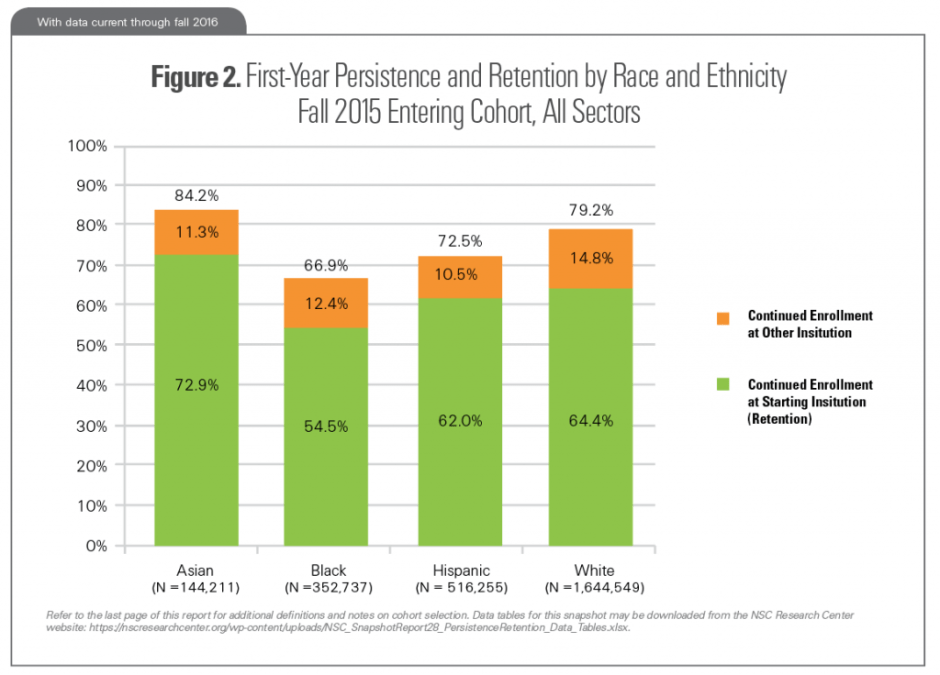
On Thursday, June 15th, the National Student Clearinghouse released their annual persistence and retention report.  Including race and ethnicity data for the first time, the report details large gaps in first-year persistence and retention data among groups.

Fig-2-Snap-28-1024x736.png

The term “persistence” in a higher education setting refers to whether or not a student returns to any institution for their second term, regardless of where they began.  “Retention” refers to whether or not a student returns to the same institution they began.

While the report has limitations (it only accounts for certain race/ethnicity groups), it surely allows a new lens for scholars and practitioners to view persistence and retention.  While Vincent’s Tinto’s (1994) work on integration and Hurtado and Carter (1997) sense of belonging have served as foundational theories and guided practice for practitioners for the past 20+ years, should they be revisited to explore these various aspects of identity?  Further research is needed to determine what factors, both positive and negative, determine an individual’s decision to be return to higher education following their Fall semester. What causes Asian students to be retained at such a higher rate than Black students? What causes Black students to persist at other institutions at a rate higher than Hispanic students? Why is our retention of all full time students, regardless of race/ethnicity, under 73% nationwide?  These are just a few of the potential research questions that need to be explored in the immediate future.

This report highlights the large gap that continues to widen among minority groups in the United States.  I ask, why?  Why, knowing this information, do we as educators, practitioners and policymakers not fix the broken system?  While there are programs and services designed to help specific populations, is it enough? Are we, as educators, maintaining the status quo? We have to do better.

A snapshot report can be found here.


Income Share Agreements: The Future of Financial Aid?

Earlier this month while reading University Business Magazine, I learned about “Income Share Agreements (ISAs),” an up and coming mechanism to finance post-secondary education.  An alternative to traditional financial aid mechanisms, ISAs allow private investment firms or institutions to front tuition costs and fees for students under the condition they will surrender a percentage of their future income for a given amount of time after they graduate.  These differ in the sense of costly expensive loans that require graduates to pay back the original student loan plus interest in monthly installments that often spread over decades.  Furthermore, ISAs are often set at a fixed rate, with no accrual of interest.  Tonio DeSorrento, CEO of Venmo Education, cited that “loans keep score with interest; ISAs keep score with incomes.”

ISAs are based on expected incomes, and therefore puts more ownership on the institution and individual to ensure expected outcomes are met.  With state and federal government holding institutions more accountable for these outcomes (i.e. a job in their field after graduation), institution sponsored ISAs (through the use of endowments) may be one avenue for them to enter the conversation.  Students must obtain a “good” job out of college for an ISA to be mutually beneficial for both parties.  However, ISAs present more of a risk for investors than student loans because the investor is hoping to get more money back (assuming the student makes more money post-graduation).    If a student is underemployed or non-employed post-graduation, they simply don’t pay.

After a quick Google search, I learned that Purdue University offered the first institution backed ISA initiative, “Back A Boiler” in the Fall of 2016.  Individuals interested in learning more about the model, can read an article published by the Atlantic on March 15th, 2017.  The success or downfall of Purdue University’s ISA program may influence the landscape of student financial assistance in the United States.  Zakiya Smith, strategy director of the Indiana-based Lumina Foundation and a former senior policy advisor for education in the Obama White House, states that “college-backed ISAs have been lauded as a way for colleges to have skin in the game with regard to the financial success of their students and to give institutions incentives to equip their students with marketable skills and support their alumni in securing employment.”

Pros:

With higher education costs and student loan debt on the rise across the United States, ISAs offer an alternative to costly student loans.  Due to the fact that ISAs are based on a person’s income, students will never pay more than they can afford.  This is in contrast to current student loan programs that require students to pay back a set amount with interest for the duration of the loan.  While some student loan programs allow for an income based repayment plan, not all students qualify.  Furthermore, ISAs often do not require a parent cosigner, which opens the door for those students who identify as first generation. Additionally, private companies and firms can offer ISAs to students in fields that are needed most or that are in high demand within a particular geographical region.  Finally, ISAs often have fixed rates, so students do not have to worry about variable interest rates.  While students may pay more utilizing an ISA over the long term, they are never paying more than they can afford.

Cons:

Currently, ISAs are not tax deductible.  Additionally, there are few state and federal regulations concerning who, what, where and when ISAs can be offered.  Furthermore, a high earning student may pay more utilizing an ISA than if they signed for a private or federal loan.  Critics of ISAs argue that it would benefit investors to select students attending top universities (those likely to be high achievers) which would not help the student loan crisis for the middle class.  As such, investors would get the biggest return on their investment.  While ISAs have received some widespread support, including policymakers such as Senator Marco Rubio, some caution that some academic fields could all together disappear if ISAs were only utilized to attract students to a particular field (for example, STEM fields).

The Future:

It remains to be seen the impact ISAs will truly have on the future of higher education and financial aid policies.  However, they are often an underutilized form of financial assistance that may be worth looking into for some students.  Scholars and practitioners should begin to look at the impact ISAs can have on maximizing student success while minimizing financial burden.

Are you practicing inclusion?

Image may contain: 2 people, people standing, sky and outdoor

On May 22nd, I had the pleasure of hosting Dr. Liza Talusan at the University of New Orleans for a one day professional development session on diversity, equity and inclusion.  Over 45 student affairs professionals participated in the workshop, including representatives from Athletics, Counseling Services, Learning Resource Center, Information Technology and Student Support Services (among others) engaging and reflecting on our practices as an institution.  While Dr. Talusan provided us with amble information and activities, the real substance of the day involved us undertaking a critical examination of each of our functional units to determine how inclusive we were.  While difficult, I believe it made our campus more welcoming, accepting and equitable for those students who represent undeserved communities on our campus.  Dr. Talusan provided us with valuable insight in a judgement free space to help us tackle often difficult and unspoken issues.

Diversity

I won’t spend a lot of time on this topic, but it’s important to note that diversity extends beyond racial, ethnic and religious affiliation.  It includes age, disAbility status, learning styles, socioeconomic status, nationality, experiences, employment status, culture, sexual orientation, gender, gender identity, income, experience, political beliefs, etc.  The list could go on and on.  It includes both visible and invisible attributes.  The Diversity Wheel, developed by John Hopkins Leadership Council, provides a visual representation.

Image result for diversity


Remember, you can have a diverse group of people, but fail to be equitable and inclusive.  Diversity does not equal inclusion.  Furthermore, the way we come to conversations about diversity are through our experiences and the manner in which we were socialized.  This is why it is difficult for some individuals to experience and/or understand diversity in a way that is meaningful.  I grew up in a rather homogeneous Caucasian environment and thus had limited experiences with diversity throughout my early education.  It was not until high school and college when I began to understand different aspects of diversity and had to reframe the way I viewed others while setting my stereotypes aside.  Upon reflection, this was a critical aspect of my development as an educator.  I now work with students quite regularly who are just coming to recognize that they may have been “fooled” while growing up.  It is not an easy task – and quite frequently – it can be painful for some.  Additionally, it often leads to conversations about power and privilege, but I’ll stop short of that today in this blog post.

Equity (and how that is different from equality)

A huge learning moment for me during the session involved learning the difference between equity and equality.  Dr. Talusan provided the following example:

Scenario: lunch room full of students who are hungry.

Equality: providing one peanut butter and jelly sandwich to all students in the lunch room.

Equity: providing one peanut butter and jelly sandwich to all students in the lunch room that meets the needs of all students (some people are allergic to peanut butter and need sunflower butter, some students can’t have white bread, other students need gluten free, etc.).

Oftentimes, college campuses strive to provide equity by utilizing equality  

An example in higher education:

Scenario: students need access to print

Equality: giving $10.00 to everyone on their Student ID card

Equity: determining which students need access to paper, computer, printer, etc.

As institutions, we need to do a better job of being both equitable and equal.  In the age of accountability (often in the form of retention and graduation rates), we as educators cannot simply ignore the fact that different students require different levels of support to be successful.  While I know this proves to be a challenge for institutions as they face decreased levels of funding, small but intentional changes can provide high impact results.

Inclusion

Are you practicing inclusion in all of your daily practices?

That was the question posed by Dr. Talusan as we neared the end of the workshop.  While difficult to answer, it is paramount that one critically reflects on the practices conducted in their functional area to ensure they are inclusive to all.  The simple change of a form (to reflect gender identity/expression) or the manner in which students pay for their classes (to reflect socioeconomic status) can make a whole lot of difference to an entire subset of your collegiate population.  As educators, we like to think we are friendly and helpful.  However, we often fail to see the ways in which we create barriers for our students.  Throughout the workshop, I found that I was extremely knowledgeable and inclusive in regards to those of different sexual orientation and gender identities, but realized I need to learn more about issues surrounding immigration status and body shape and size.  As such, I didn’t think of those aspects of diversity and inclusion as much when planning various programs or offering services.  Am I perfect?  No.  Do I have room to grow? Absolutely.  Find a trustworthy colleague and/or student and ask them the ways in which you or your unit can become more open and accepting.  You may just be surprised….

Advice from my PhD journey

IMG_1217


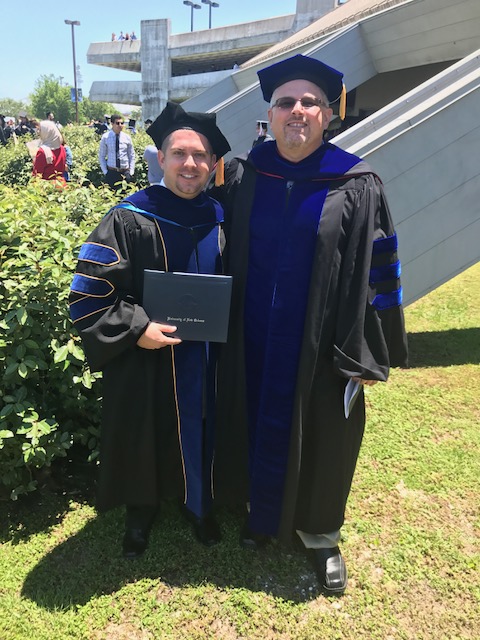
Dr. Michael Hoffshire (left) and major professor Dr. Chris Broadhurst (right)


It has been a little over a week since I graduated with my doctoral degree in Educational Administration from the University of New Orleans.  It still hasn’t quite set in, aside from the formal graduation ceremony and an abundance of cards from family and friends.  Several individuals have asked me if I feel any different – but truthfully, I do not.  I’m still the educator, practitioner and scholar I was before the degree program began, except I’m much more knowledgeable about the field and methodological practices to produce solid research.  My passion and desire to be the best higher education practitioner/educator has never left me and I hope it never will.  I’d even be willing to argue it has become stronger.  I wanted to share some reflections of my journey in the hope of assisting those who are beginning or are in the thick of pedagogy, methods, theoretical/conceptual frameworks, data collection analysis, findings and implications for practice.

Consider why you began and are on this journey.

The path to earning a doctoral degree is not for the weak of heart.  Before enrolling in a program, I would encourage you to think long and hard regarding the sacrifices you will have to make.  This includes potentially spending less quality time with family and friends, balancing a course schedule with an assistantship, part time/full time job and taking a step back from some of your other passions/commitments.  For me, I had to volunteer less (or at times, not at all) at our local animal shelter and stop playing in a recreational softball league.  It also included saying “no” to some of my friends when they wanted to do something.  It wasn’t always easy – but I made those sacrifices as I wanted to earn my doctoral degree in higher education and research LGBQ+ students in their career development.  For others, it may delay a significant life event, such as having children or buying a house.  I was fortunate to not have a ton of outside commitments while in the program, as my family did not live close by, I wasn’t in a long term relationship and I didn’t have any children or other individual to care for.  Analyze your situation as well as consult with any significant stakeholders in your life (particularly children and significant others) before enrolling in a degree program.

We all have our own reasons for embarking on a doctoral journey.  It’s important that you can articulate that to a wide audience and that you make a commitment to the process.  For me, I want to enact change at a large scale level at our institutions. Additionally, I want to give a voice to underrepresented and marginalized students on campuses nationwide.  You will be questioned by a lot of people along the way, especially when you are making sacrifices and because you are going into a field that is not always the most financially stable.  Trust your instincts and make the right decision for you.  Most importantly, when the going gets tough, remember these reasons for starting the program.  It will get you through.

Trust the process.

You will take what seems to be an endless amount of classes, sit for qualifying and general exams, submit a proposal, edit the proposal, submit your proposal and defend it in front of your committee.  Be sure to choose a topic you are willing to work on for at least the next 4-6 years.  You’ll then gain IRB approval and begin writing your dissertation.  You’ll likely spend 6 months to a year, if not longer, collecting and analyzing data all while considering implications for theory and practice.  After submitting the first draft to your chair, you’ll dread receiving it back knowing the endless amount of feedback and edits you’ll have to make before continuing on in the process.  You’ll feel excited and hopeless at the same time.  You’ll be excited and nervous to defend your completed dissertation to your committee.

My advice here is to trust the process (borrowed for Dr. Matt Wawrzynski at Michigan State).  Be excited and happy when you understand a theory or concept, finally understand conceptual frameworks or how to conduct a chi-squared test or receive solid feedback on a group assignment.  Also remember that it is okay to stumble and fall – as long as you get up, brush yourself off, and try again.  I’d argue that you didn’t learn how to ride a bike on your first try, so it is highly unlikely you are going to understand all the concepts, methodology and/or methods on the first go around.  If obtaining a doctoral degree was easy, more people would do it.

Continue to have a social life.

So many people in my life asked me how I was able to maintain my sanity throughout the process, and truthfully, it was because I refused to become a hermit and give up my social life.  I became very good at time management and holding myself accountable to researching and writing deadlines, and rewarded myself with social outings with friends and family.  For me, I found that writing non-stop on most weekends worked best.  Other times, I stayed after work each day and wrote so I could go out on the weekends.  This allowed me time to go out and do things after work and classes during the week.  You are going to have to find what works for you.  I have friends that choose to write in the morning and others that choose to write during the week.  Either way, find one or two things outside of the dissertation to keep your sanity.

You will think you are about to quit the program 3 – 5 times.

This happened to me a few times throughout my process, and several people in my cohort have expressed similar feelings.  I legit thought I was going to give up.  There were times of great uncertainty – when I questioned everything that was to know about myself, the field and my topic of study.  Why was I putting myself through this? Why and is my topic even relevant anymore? What is the benefit of obtaining a PhD?

During times of great distress, I immediately set up meetings and phone calls with my support system, including my major professor.  Oftentimes, they would talk me off the ledge and remind me why I entered the program in the first place.  I’d sit down with my committee members during office hours and have them explain major points or concepts to me in a different manner than they did in class.  I’d Facetime or Skype with loved ones to offer me an encouraging word.  If it wasn’t for them, I surely would have given up.  I’ve seen too many people walk away from their program, and I didn’t want to become one of them.  It was times of great distress and anxiety that I went back to the reasons I decided to enter the program and the implications my research would have for the field.  Identify your support system early.  Go to class together, debrief together, critique each other’s work together and most importantly – commiserate together.  No one truly knows what it’s like to be a doctoral student unless they are one.

12112467_10100383866121361_13477622768245597_n

Me and Doctoral Candidate Christy Heaton (right)

Work on a research project with a faculty member.

Towards the end of my coursework, I was given an opportunity to work with a few faculty members on a research project with the long term goal of publication.  It was one thing to learn about how to conduct a research study in class, but it is at a whole new level when you are actually out in the field.  Working on this research project gave me the practical application of many of the theoretical constructs we studied in class.  It also gave me a “practice run” of conducting a research study, from start to finish, before I had to conduct my dissertation study.  The experience was invaluable and I would encourage you to reach out and do the same.  If you are interested in checking it out, here is the APA citation:

Broadhurst, C., Martin, G., Hoffshire, M., & Takewell, W. (2016). “Bumpin’ up against   people and their beliefs”: Narratives of student affairs administrators creating change for LGBTQ students in the South. Journal of Diversity in Higher Education.

I could go on forever about my experience.  If you are reading this and would like to process about whether or not a doctoral program is for you or you need an extra push to make it through the last stage in the process, do not hesitate to drop a message.  I’d love to continue to this conversation and more than happy to help.

Until next time!

Blog Introduction

Good Wednesday Morning!

Thank you for taking the time to check out my website! For those of you who haven’t had the opportunity to read the about me section of my website, I’m Dr. Michael Hoffshire.  I’m excited to be involved in a community of research, scholars, and practitioners who tirelessly devote their life to the success of students in higher education.  I’m even more excited to give back to the profession that has provided me with so much growth and development.  The opportunity to impact students, faculty, staff and administrators on a large scale across the United States has led to the creation of this website and hopefully, the opportunity to visit some of your institutions.

This blog will also serve as a place to engage in a critical discussion of some of the pressing issues and concerns in our field, as well as a forum to share my thoughts, feelings and insights about the current state and future direction of higher education and student affairs practice.  I encourage you to share when a topic resonates with you as well as contribute in the form of comments and critical dialogue.   Please also know that I recognize technology cannot replace the face to face interaction and learning that can result from in person discussions.  While you may not always agree with my thoughts, feelings and comments, it is my hope that we can engage in civil discourse to learn from one another.  After all, we must role model the same expectations we set for our students.

I am currently working on a blog post that offers a reflection of my doctoral journey from the perspective of a recent graduate.

Here are some topics I have been brainstorming that may be serve as future blog posts:

  • Recruitment and Hiring Practices
  • Student Leader Skill Sets and Transferability
  • Navigating the Political Environment of Institutions
  • Finding Your Fit In a Job
  • What Does “Other Duties As Assigned” Really Mean?
  • Revisiting Kuh’s High Impact Practices for Student Learning and Engagement
  • “Guest” Blog Posts
  • Creating a Social Life

Until next time…..